
What is a CDN? Why do businesses need a CDN?
A CDN (Content Delivery Network) is a distributed network of servers designed to deliver website content including images, videos, and static assets from locations closest to end users. By caching and serving content at the edge, a CDN significantly reduces latency, improves load speed, and enhances overall website stability, especially for high traffic environments.
Businesses should consider adopting a CDN for the following reasons:
- Faster website performance: A CDN minimizes the physical distance between users and servers, substantially reducing latency.
- Improved user experience: Fast and stable page delivery increases user retention and lowers bounce rates.
- Enhanced security posture: Modern CDN platforms integrate DDoS mitigation, traffic filtering, and encryption capabilities to protect against cyber threats.
- Reduced origin server load: By distributing traffic across multiple Points of Presence, or PoPs, a CDN prevents origin overload during traffic spikes.
- Seamless scalability: A CDN enables infrastructure scaling without significant capital investment in bare metal servers.
For these reasons, CDN technology has become a foundational component in modern web and digital application architectures.

Key criteria for evaluating CDN providers
When selecting a CDN provider, organizations should assess several critical factors to ensure alignment with their technical requirements and growth strategy.
Performance and latency
CDN performance directly impacts page load speed, particularly for high traffic websites. Providers with an extensive global PoP footprint can significantly reduce latency and accelerate content delivery. For businesses operating in Vietnam, choosing a local CDN provider or a vendor with in country PoPs can dramatically improve user experience for domestic traffic. In addition, video delivery optimization is increasingly important. Platforms that support adaptive streaming and optimized media distribution are essential for video streaming services and media rich applications.
Infrastructure scale and PoP footprint
Infrastructure capacity and the number of PoPs determine both speed and service resilience. Providers such as Cloudflare, Akamai Technologies, and VNCDN operate thousands of PoPs globally, enabling content to be served from locations closest to users. For businesses targeting Vietnamese audiences, selecting a CDN with PoPs deployed within major domestic ISPs can significantly enhance regional performance.
Cost structure and scalability
CDN pricing models typically depend on bandwidth consumption, request volume, or data transfer usage. Organizations should evaluate pricing tiers in relation to projected traffic and budget constraints. Some providers offer entry level plans suitable for small businesses, while enterprise plans include advanced security features and premium support. Scalability is equally important. A robust CDN must automatically adapt to traffic surges during peak events such as Black Friday campaigns or Lunar New Year promotions.
Technical support and SLA
Reliable technical support is essential for production environments. Reputable CDN vendors provide 24 by 7 support to ensure rapid incident resolution. Service Level Agreements, or SLAs, define uptime guarantees and response times. Businesses should prioritize providers with strong SLA commitments to ensure continuous and stable service delivery.
Comparison of leading CDN providers
VNCDN - Leading CDN provider in Asia
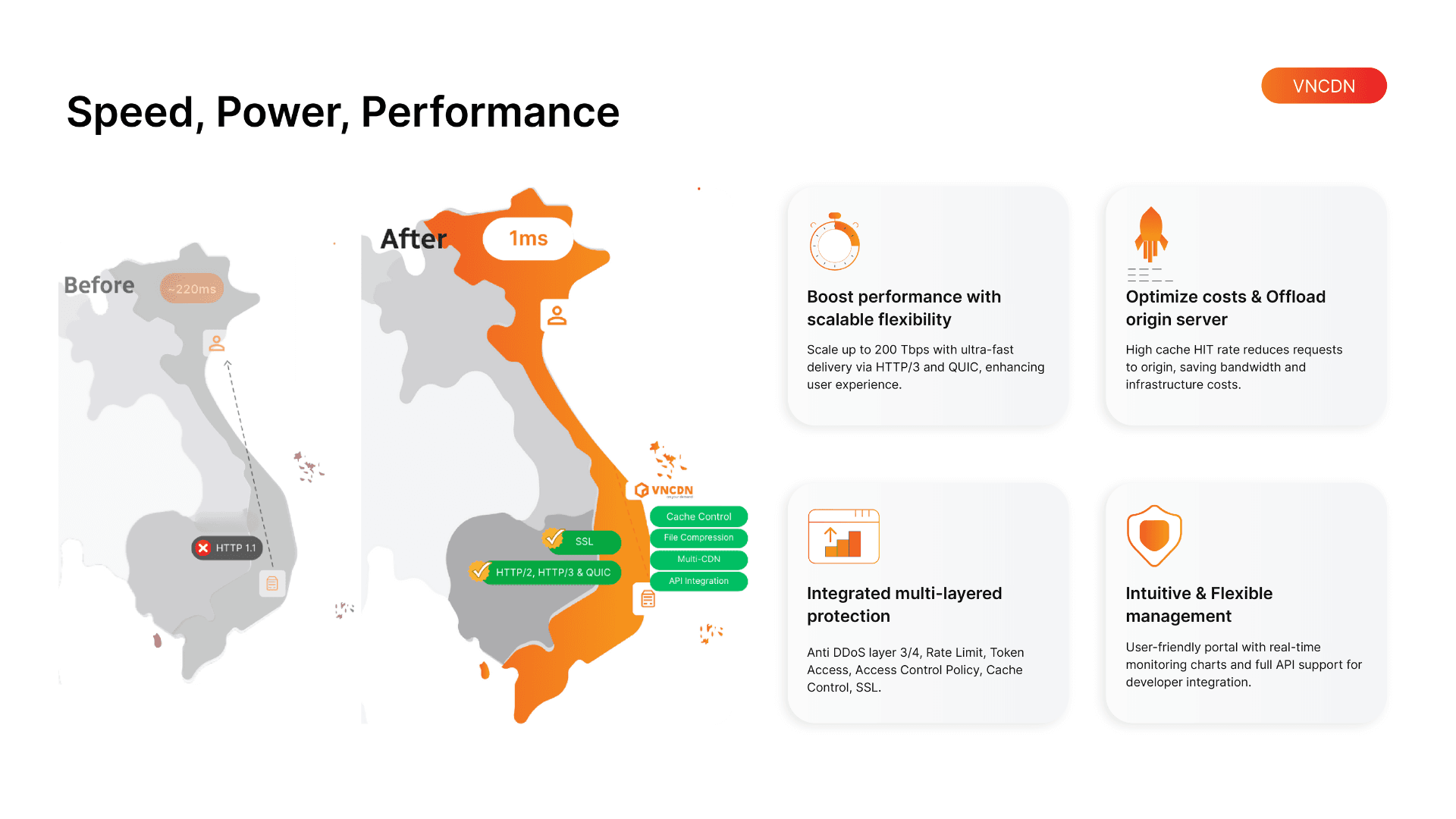
VNCDN is a CDN platform developed by VNETWORK, designed to optimize content acceleration, security, and cost efficiency for businesses in Vietnam and across Asia. The solution enhances domestic performance while maintaining flexible scalability for high traffic scenarios.
Key strengths:
- Performance and infrastructure coverage: VNCDN operates over 2,300 PoPs across more than 146 countries and is deployed within major Vietnamese ISPs such as Viettel, MobiFone, VNPT, and FPT. The infrastructure supports more than 10 million concurrent users and processes over 20 billion requests per day, ensuring low latency and stable performance.
- Modern transport protocols and bandwidth capacity: VNCDN supports HTTP 3 and QUIC to improve connection speed and stability. Domestic bandwidth exceeds 15 Tbps, while international capacity reaches over 200 Tbps, making it suitable for large scale livestreams and peak commerce events.
- Cost optimization and origin offload: Intelligent caching reduces origin requests, lowering bandwidth consumption and operational costs. For businesses with a predominantly Vietnamese user base, VNCDN maximizes infrastructure return on investment.
- Integrated security and DDoS mitigation: Built in Layer 3 and Layer 4 DDoS protection, rate limiting, token based access control, and SSL encryption safeguard systems at the content delivery layer. Combining acceleration and security within a unified platform reduces service disruption risks.
- Content acceleration ecosystem: Beyond CDN services, VNCDN integrates HLS streaming, a Video Management System, and Cloud Storage. This ecosystem model is well suited for video platforms, online education, and digital services requiring large scale, stable media distribution.
Best suited for:
E commerce platforms, media organizations, financial institutions, online education providers, and digital services with a primary user base in Vietnam and Asia, especially those managing short term high traffic spikes such as livestreams and promotional campaigns.
With more than 12 years of infrastructure deployment experience, VNETWORK has served over 2,000 customers including VTV, TikTok, VnExpress, Báo Thanh Niên, and MoMo. During Vietnam National Day celebrations on September 2, VNETWORK collaborated with VTV to ensure stable large scale video streaming for millions of viewers across multiple devices, demonstrating proven operational capability at scale.

Cloudflare
Cloudflare is a globally recognized CDN provider known for rapid deployment and integrated multi layer security.

Key strengths:
- Global PoP coverage optimized for multinational audience
- Built in automatic DDoS protection, Web Application Firewall, and DNS security
- Support for dynamic content caching and API optimization
- Fast onboarding through DNS configuration, including a free tier
Best suited for:
Startups, SaaS platforms, and businesses with international traffic seeking quick CDN deployment combined with baseline security integration.
Amazon Web Services CloudFront
Amazon Web Services CloudFront is the CDN service within the AWS ecosystem, designed to integrate seamlessly with services such as Amazon S3, EC2, and Elastic Load Balancing.
Key strengths:
- Deep integration with AWS services for centralized management
- Automatic global scaling
- Enhanced security through AWS Shield and AWS WAF
- Strong support for API delivery and cloud native applications
Best suited for:
Technology companies and SaaS providers operating backend infrastructure on AWS who require unified cloud governance.
Akamai Technologies
Akamai Technologies is one of the most established CDN providers, widely adopted in enterprise environments.

Key strengths:
- Extensive global network optimized for media streaming
- Enterprise grade DDoS mitigation and advanced security services
- Support for dynamic content, APIs, and complex applications
- Strong track record in financial and media sectors
Best suited for:
Multinational corporations, banks, financial institutions, and large scale media platforms requiring high SLA commitments and global stability.
Fastly
Fastly focuses on edge computing and real time content processing, offering granular configuration control.
Key strengths:
- Near real time cache invalidation
- Developer centric configuration flexibility
- Optimized for APIs and frequently updated content
- Integrated security and edge logic
Best suited for:
Technology companies, marketplaces, and API driven systems requiring real time updates and advanced technical control.
Quick comparison of CDN services
| Provider | Infrastructure scope | Deployment in Vietnam | Notable features | Best suited for |
| VNCDN | Vietnam and Asia focused with global expansion | Deployed across major Vietnamese ISPs | HLS, VMS, Layer 3 and 4 DDoS protection, intelligent caching | E commerce, content platforms, online education, finance, high traffic applications in Vietnam and Asia |
| Cloudflare | Global | Regional PoPs available | Integrated DNS, DDoS protection, WAF, Zero Trust | Startups, SaaS, multinational websites requiring rapid deployment |
| AWS CloudFront | Global | Dependent on AWS configuration | S3 integration, Lambda at the edge, AWS Shield | AWS based enterprises, cloud native platforms, API delivery |
| Akamai | Global | Global distribution | Enterprise CDN, advanced security | Multinational corporations, banks, large media platforms |
| Fastly | Global | Global distribution | Edge logic, real time purge, API delivery | Technology companies, marketplaces, API platforms |
| Azure CDN | Global | Dependent on Azure region | Microsoft ecosystem integration | Enterprises operating on Microsoft Azure infrastructure |
Which CDN should Vietnamese businesses choose?
Selecting the right CDN is not solely about global scale. It must align with user distribution, operational strategy, and performance requirements. For Vietnamese businesses, domestic optimization and local technical support often play a decisive role.
If the majority of traffic originates from within Vietnam, a CDN deployed directly within domestic ISPs such as VNCDN can significantly reduce latency and ensure stability during peak periods. Conversely, organizations running infrastructure on AWS or Azure may prefer integrated CDN services within the same ecosystem to streamline governance and operational efficiency.
Ultimately, no single CDN solution fits every business model. Companies should evaluate real world requirements and long term strategy to ensure consistent performance, cost efficiency, and future scalability.
FAQ about CDN services
1. Does a CDN replace hosting?
No. A CDN operates alongside the origin server. It distributes static and certain dynamic content from edge locations, while hosting infrastructure remains responsible for primary data storage and processing.
2. Do small businesses need a CDN?
Even small and medium sized websites can benefit from CDN adoption. A CDN improves load speed, enhances user experience, and reduces origin server load, particularly during marketing campaigns or sudden traffic surges.
3. Can a CDN mitigate DDoS attacks?
Most modern CDN providers integrate DDoS protection at various levels. By distributing traffic across multiple PoPs, a CDN reduces the likelihood of origin server overload. The level of protection depends on the selected service plan and security configuration.
4. Should you choose a domestic or international CDN?
The decision depends on primary user geography. If most traffic originates from Vietnam, a CDN with in country infrastructure can optimize latency. For multinational audiences, a global CDN may be more appropriate.
5. Does a CDN impact SEO?
Yes. Page load speed influences user experience and search engine rankings. By improving performance and reducing response times, a CDN indirectly supports SEO effectiveness.
6. Will CDN deployment cause downtime?
In most cases, CDN deployment does not interrupt website operations when properly configured. Implementation typically involves DNS updates or reverse proxy configuration. It is recommended to deploy during off peak hours with technical monitoring in place.
7. Does a CDN automatically scale during traffic spikes?
Most modern CDN platforms are designed with automatic scalability. They dynamically adapt to traffic fluctuations, allowing websites to remain stable during flash sales, livestream events, or major campaigns without immediate origin infrastructure upgrades.